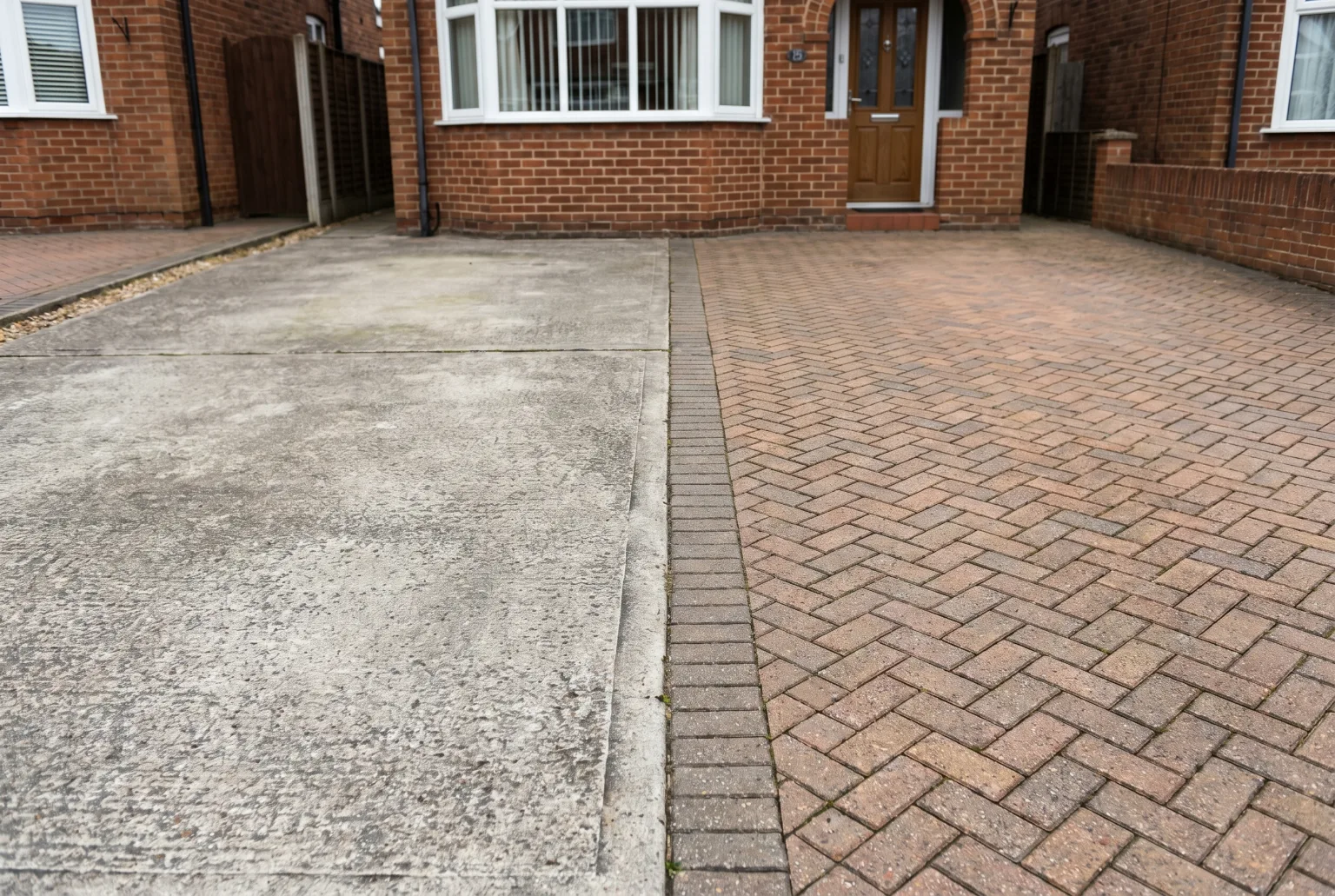
Concrete vs Block Paving
Block paving looks great in the showroom. But ask anyone who's had it for 10 years and you'll hear the same three words: sinking, weeds, moss. Here's the honest comparison with concrete, upfront cost, lifetime cost, and what actually happens over 20 years.
Quick answer
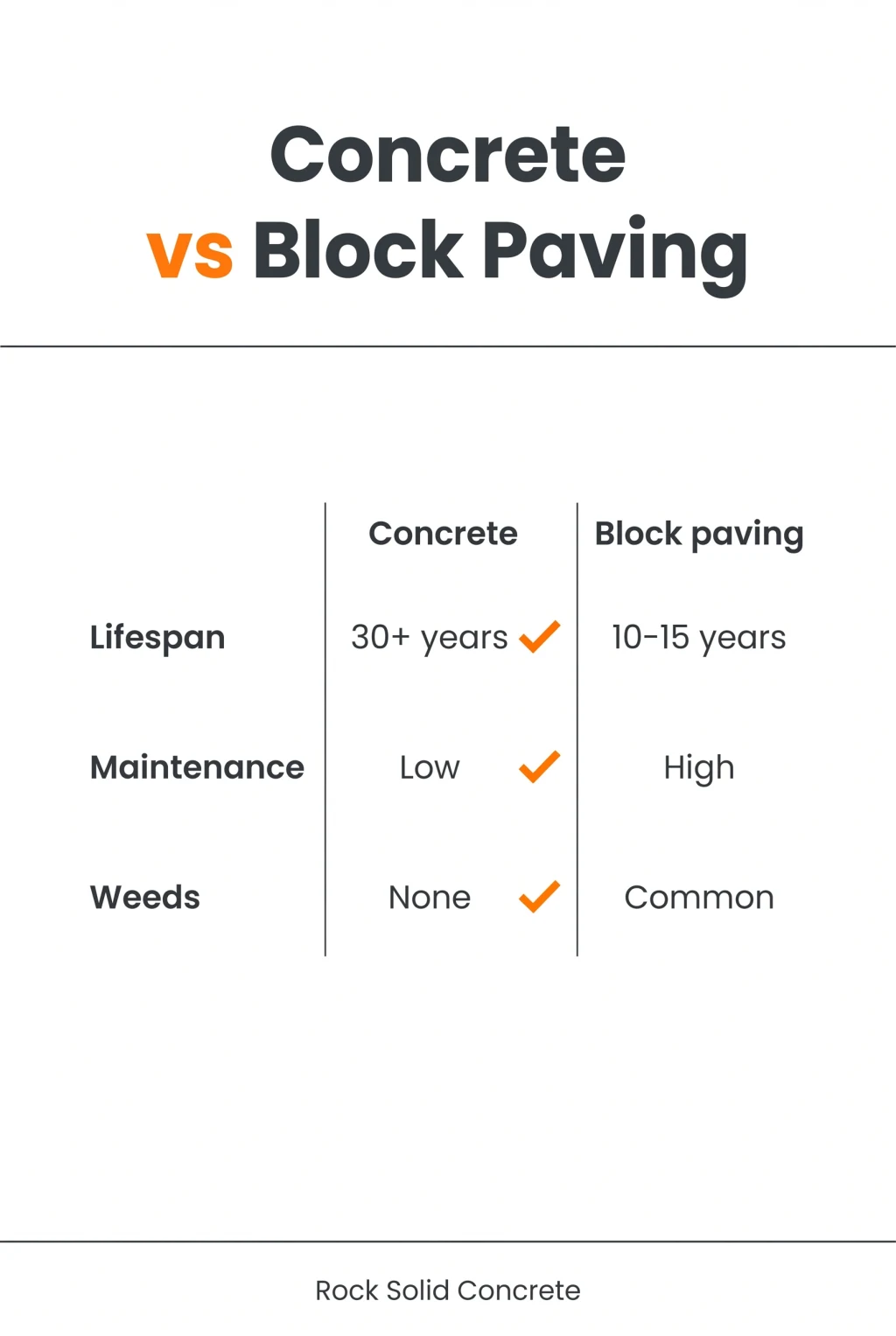
For a driveway, concrete is usually cheaper to install, lasts 30 years or more, and needs little maintenance. Block paving offers more pattern and colour choice and easy spot repairs, but tends to sink, weed, and need re-sanding within 10 to 15 years. Pattern-imprinted concrete gives the looks without that upkeep.
The Headline Numbers
Where Block Paving Wins
- Aesthetic variety, hundreds of colour, size, and pattern combinations
- Spot-repair, lift one damaged block, replace it, move on
- Permeable options, meets SuDS / planning permeability requirements without extra drainage
- Kerb appeal on resale, some buyers specifically look for paving
Where Concrete Wins
1. It doesn't sink
Block paving sits on sand over a sub-base. Over time, cars compact ruts into the wheel-paths and blocks tilt. A single concrete slab spreads the load evenly, no ruts, no tilt.
2. It doesn't grow weeds
The weed seeds that germinate between paving joints simply have nowhere to root on a continuous concrete surface. Zero weed killer, zero re-pointing.
3. It's faster to lay
A 25m² concrete driveway is one day's work: dig, prep, pour, finish. The equivalent block paving is 3-5 days of laying, cutting, compacting, and filling joints.
4. It handles heavier loads
C32/40 concrete with A142 mesh handles regular HGV or RV use. Block paving rated for heavy vehicles is expensive and still channels loads into the sub-base.
5. The finish is your choice
Brushed
Standard textured finish, slip-resistant, practical, honest-looking. The default for driveways.
Stamped
Pattern-imprinted to mimic flagstone, slate, cobble or timber. 30% cheaper than the real thing, identical look from 3 metres away.
Coloured
Integral colour added at the plant, red, buff, charcoal, graphite, green tones. Consistent, fade-resistant, no surface stain.
Exposed aggregate
Acid-wash or brush-wash reveals the stone in the mix. Natural, durable, a bit more expensive, but stunning with the right aggregate.
The 20-Year Reality Check
Pick any 20-year-old block paving driveway in your area and walk it. You'll almost certainly see:
- Ruts where cars park, differential sinking
- Weeds growing in joints despite annual weeding
- Moss in the shade under the hedge
- One or two cracked blocks waiting for replacement
- Faded surface colour that won't come back even with pressure-washing
Now walk a 20-year-old concrete driveway. You'll see a driveway. Possibly with some surface weathering. Still doing its job. That's the point.
When Block Paving Makes Sense
Block paving is a good choice when:
- Planning permission requires a permeable surface (though permeable concrete is also an option)
- Your aesthetic vision is very specific and the concrete finish won't match
- You want easy spot-repair because you live in an area with frequent service-trench digging
- Your drive is small (under 15m²) where the lifetime cost difference is minimal
When Concrete Is the Obvious Choice
- Long driveways or large areas, the economics strongly favour concrete
- Heavy vehicle use, RVs, campervans, regular trade vehicles
- Rural or farm access, concrete stands up to tractors and trailers
- Low-maintenance homeowners, you don't want to revisit this in 10 years
- Base layer for resin-bound surfacing, resin needs a concrete slab underneath
The Hybrid Approach
You don't have to choose one or the other. A popular pattern across the Midlands:
- Block paving at the front of the house where aesthetic matters most (~10m²)
- Concrete for the main driveway run and turning area (~25m²)
- A stamped or coloured concrete finish can even blend the two visually
Lifetime cost works out close to pure block paving, but most of the maintenance burden is gone.
Concrete vs Block Paving FAQs
Is concrete or block paving better for a driveway?
Concrete is lower maintenance and longer lasting, with no weeds or sinking between blocks. Block paving offers more pattern and colour choice and easier spot repairs. For value over 20 years, poured or pattern-imprinted concrete usually wins.
Is concrete cheaper than block paving?
Concrete is usually cheaper to install and much cheaper over its lifetime, since block paving needs re-leveling, weed control, and re-sanding. Pattern-imprinted concrete costs more upfront but still avoids those maintenance jobs.
How long does a concrete driveway last?
A properly laid concrete driveway on a good sub-base lasts 30 years or more. Block paving often needs lifting and re-leveling within 10 to 15 years as blocks sink or shift.
Does block paving need more maintenance than concrete?
Yes. Block paving needs regular weeding, re-sanding of the joints, and occasional re-leveling. A sealed concrete driveway needs little more than an occasional clean.
Ready to price a concrete driveway?
Instant price in 60 seconds, just your size and finish choice. Delivered across the Midlands from our Coventry and Melton Mowbray plants.