
How to Mix Concrete
A step-by-step UK guide for mixing concrete by hand or with a small mixer, mix ratios, water proportions, and when ordering ready-mix is the better answer.
The Short Answer
How do you mix concrete?
For most domestic DIY pours, use a 1 part cement : 2 parts sharp sand : 3 parts aggregate mix by volume. Combine the dry ingredients first until consistent, then gradually add water (about half a bucket per bucket of cement) until the mix looks like thick porridge, holds its shape but slumps slowly. Pour, screed and finish within 30 minutes. For pours over 0.5m³, ordering ready-mix is cheaper, stronger and faster than hand-mixing.
Mix Ratios
What mix ratio do you need?
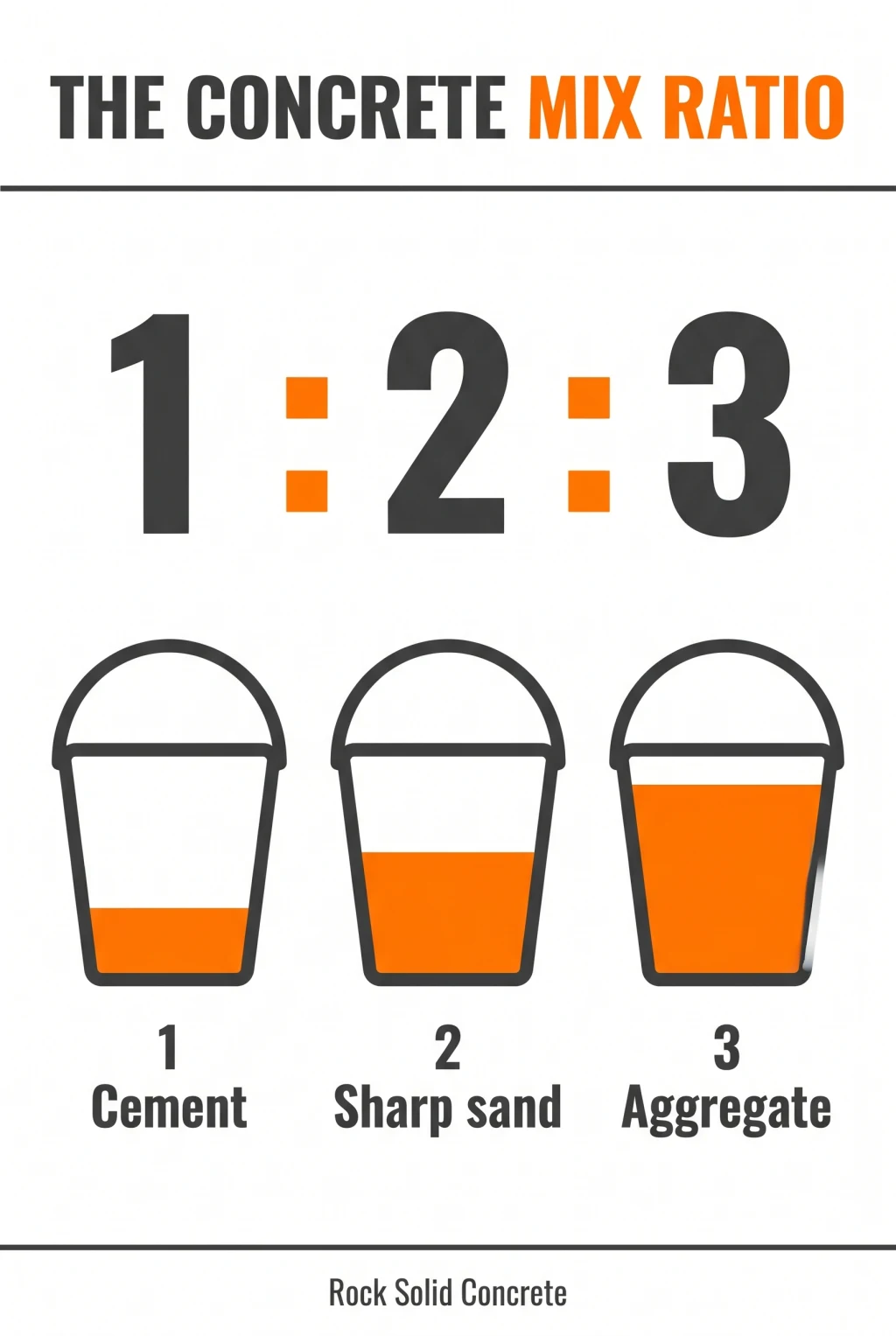
Concrete strength is determined by the ratio of cement to aggregate. Higher cement content = higher strength. The right ratio depends on what you're building.
| Ratio | Cement : Sand : Aggregate | Strength (N/mm²) | Use for |
|---|---|---|---|
| Lean-mix | 1 : 3 : 6 | ~10 | Blinding under foundations, kerb backing, lean fill |
| Standard 1:2:3 | 1 : 2 : 3 | ~20 | Paths, fence posts, small bases, garden walls, most DIY pours |
| Strong 1:1.5:2.5 | 1 : 1.5 : 2.5 | ~25-28 | Driveways, garage floors, shed bases, anything taking vehicle weight |
| Heavy-duty 1:1:2 | 1 : 1 : 2 | ~35 | Hot tub bases, slabs taking heavy machinery, structural pours |
Note: these are approximate volumes for hand-mixed DIY concrete. For specified-strength pours (e.g. C28/35 to Building Control spec), order ready-mix concrete, it's batched to BS EN 206 / BS 8500 and comes with a BSI Kitemark batch ticket.
The Method
7-step guide to mixing concrete by hand
- 01
Choose the right mix ratio
For most domestic DIY pours (paths, fence posts, small bases), use 1 part cement : 2 parts sharp sand : 3 parts aggregate (1:2:3 by volume). For higher-strength jobs (driveways, garage floors, anything taking vehicle weight), use 1:1.5:2.5. The aggregate gives strength; the sand fills the gaps; the cement binds it all together.
- 02
Measure the dry ingredients
Use a bucket as your measure, same bucket each time. For a typical 1:2:3 mix, that's 1 bucket cement, 2 buckets sand, 3 buckets aggregate. One bucket of cement (~14kg) plus 2 sand and 3 aggregate makes around 0.05m³ of finished concrete, enough for one or two fence post holes.
- 03
Combine the dry materials
Tip the cement, sand and aggregate into a wheelbarrow or onto a clean mixing tray. Mix dry with a shovel until you can't see distinct streaks of cement, typically 10-12 turns of the shovel. A consistent dry mix is the foundation of good concrete.
- 04
Add water gradually
Make a well in the centre of the dry mix and pour in water, about half a bucket per dry mix bucket of cement, to start. Mix from the outside in. Add more water in small splashes until the concrete is plastic and workable but not sloppy: it should hold its shape when piled with a shovel and only slowly slump back.
- 05
Test the consistency
Stand a shovel in the mix. If it leaves a sharp ridge that doesn't slump, it's too dry. If the ridge slumps immediately and the surface is shiny with water, it's too wet, add more dry mix in 1:2:3 proportion. Properly mixed concrete looks like thick porridge.
- 06
Pour and place within 30 minutes
Hand-mixed concrete starts to stiffen 30-45 minutes after the water hits the cement. Mix only as much as you can place in 20 minutes, pour, screed, tamp and float before it firms up. Don't add water to retemper a stiffening mix; that weakens the concrete.
- 07
Cure for at least 3 days
Cover the freshly placed concrete with polythene or damp hessian. Keep it moist for 3 days minimum. Don't walk on it for 24-48 hours, don't load it for 7 days, full strength at 28 days.
When Hand-Mixing Doesn't Pay
When ready-mix concrete beats hand-mixing
Hand-mixing makes sense for very small jobs, a single fence post, a kerb repair, patching a path. Above about 0.5m³, ready-mix wins on cost, strength and time.
Hand-mix or DIY bag mix
- ~£5-£8 per 25kg bag of postcrete
- ~25 bags per m³ at typical pour rate
- Effective cost: £125-£200/m³
- Variable strength batch-to-batch
- Hours of mixing labour
- No batch certification
Ready-mix C25/30 delivered
- £115-£135 per m³ delivered (1m³+)
- Batched to BS EN 206 / BS 8500
- Effective cost: £115-£135/m³
- Consistent strength across the load
- ~30 minutes to pour vs hours of mixing
- BSI Kitemark batch ticket
See our ready-mix concrete pricing guide for typical UK ranges by mix grade. Order from 1m³ minimum with no small-load surcharge, the break-even versus hand-mixing is around 0.5m³.
FAQ
Common questions about mixing concrete
What is the best mix ratio for concrete?
1 part cement : 2 parts sharp sand : 3 parts aggregate (1:2:3 by volume) is the standard mix for most domestic DIY concrete, paths, fence posts, small bases. For higher-strength jobs like driveways and garage floors, use 1:1.5:2.5. For lean-mix or blinding, 1:3:6 is sufficient.
How much water do I add when mixing concrete?
Roughly half a bucket of water per bucket of cement, added gradually until the mix is plastic and workable. Properly mixed concrete looks like thick porridge, holds its shape when piled with a shovel but slumps slowly. Too much water weakens the concrete dramatically; aim for the minimum amount that gives a workable mix.
Is hand-mixed concrete as strong as ready-mix?
Almost never. Ready-mix concrete is batched at a plant to a specified mix design with consistent water-to-cement ratio and aggregate grading, then BSI Kitemark certified. Hand-mixed concrete varies from batch to batch, often has too much water, and can't easily achieve the higher mix grades (C28/35+). For anything over about 0.5m³, ready-mix is cheaper, stronger and faster.
When is hand-mixing better than ordering ready-mix?
For very small jobs, 1-3 fence posts, patching a kerb, a small repair, hand-mixing a single bag of postcrete or premix is more convenient than ordering a 1m³ ready-mix delivery. The break-even is around 0.5m³. Above that, ready-mix wins on cost, strength and time.
How long do I have to use hand-mixed concrete after adding water?
Roughly 30-45 minutes from the moment water hits the cement, depending on temperature. In hot weather it can be as little as 20 minutes; in cold weather up to an hour. Don't try to retemper a stiffening mix with more water, it permanently weakens the set concrete.
Can I mix concrete in a wheelbarrow?
Yes, for small batches up to ~50kg of finished concrete (around 0.025m³). Above that, a small electric or petrol mixer is faster, more consistent and far less work. For pours over 0.5m³, ordering ready-mix concrete delivered is almost always the better answer.
What's the difference between concrete and mortar mix?
Concrete contains aggregate (gravel) for compressive strength and is used for slabs, foundations, and structural pours. Mortar is cement, lime and sand only, no aggregate, and is used for bedding bricks, blocks and pointing. They are not interchangeable; using mortar where concrete is needed gives a much weaker, crumbly result.
Related Guides
More on concrete and DIY pours
Pour over 0.5m³? Skip the mixing.
Ready-mix concrete delivered from 1m³, BSI Kitemark certified, no surcharge. With volumetric, only pay for what's poured.