The Concrete Pumping Guide
Half the jobs that end up needing a pump didn't plan for one. You book a wagon, it arrives, and there's no way to get the concrete where it needs to go, so you're wheelbarrowing 10m³ across a lawn. This guide helps you spot when a pump is the right call, and what to expect when you book one.
Quick answer
Book a concrete pump when a mixer truck cannot reach the pour, such as a rear garden, basement, or upper floor. Line pumps suit smaller, tight-access jobs; boom pumps place concrete at height or over buildings. Pumping is charged on top of the concrete, so book both together.
When should I book a pump?
Book a pump if any of the following are true:
- The wagon can't get within 3-4m of the pour, e.g. back garden, terraced house, narrow access
- The pour is above ground level, upper-floor slabs, raised conservatory, basement backfill
- It's a long chute over distance, more than ~20m of wheelbarrowing across rough ground
- Tight access, through a house, up a flight of steps, around parked cars
- You're pouring 5m³+ and the team is small, manual handling quickly becomes the bottleneck
The rule of thumb: if moving the concrete by hand would take longer than the pour itself, a pump pays for itself.
Line pump vs boom pump, which do you need?
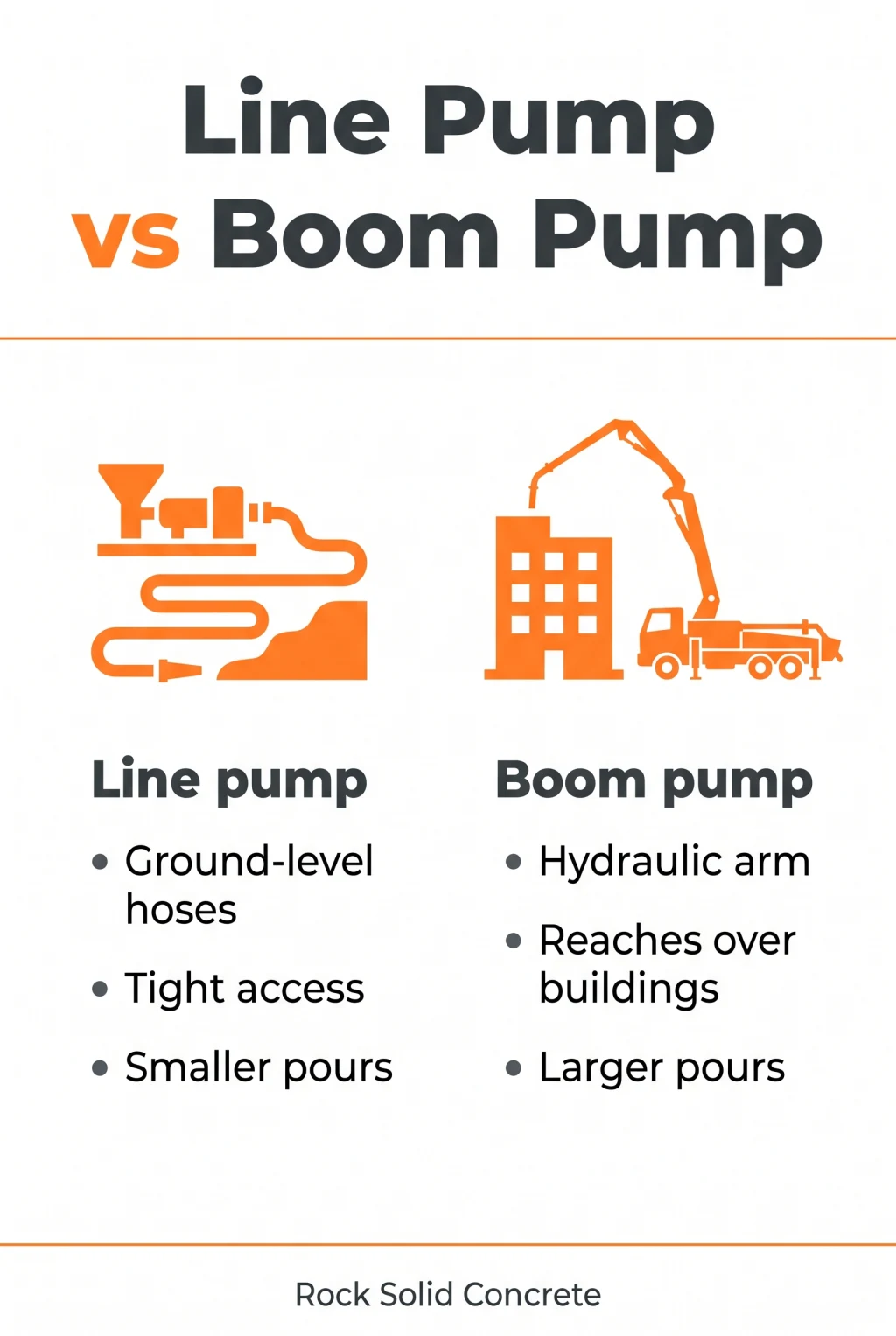
Line pump (also called static or trailer pump)
Sits on the road and pushes concrete through rubber hoses along the ground. Flexible, can be fed by hand into tight spaces. Ideal for most domestic jobs.
Boom pump
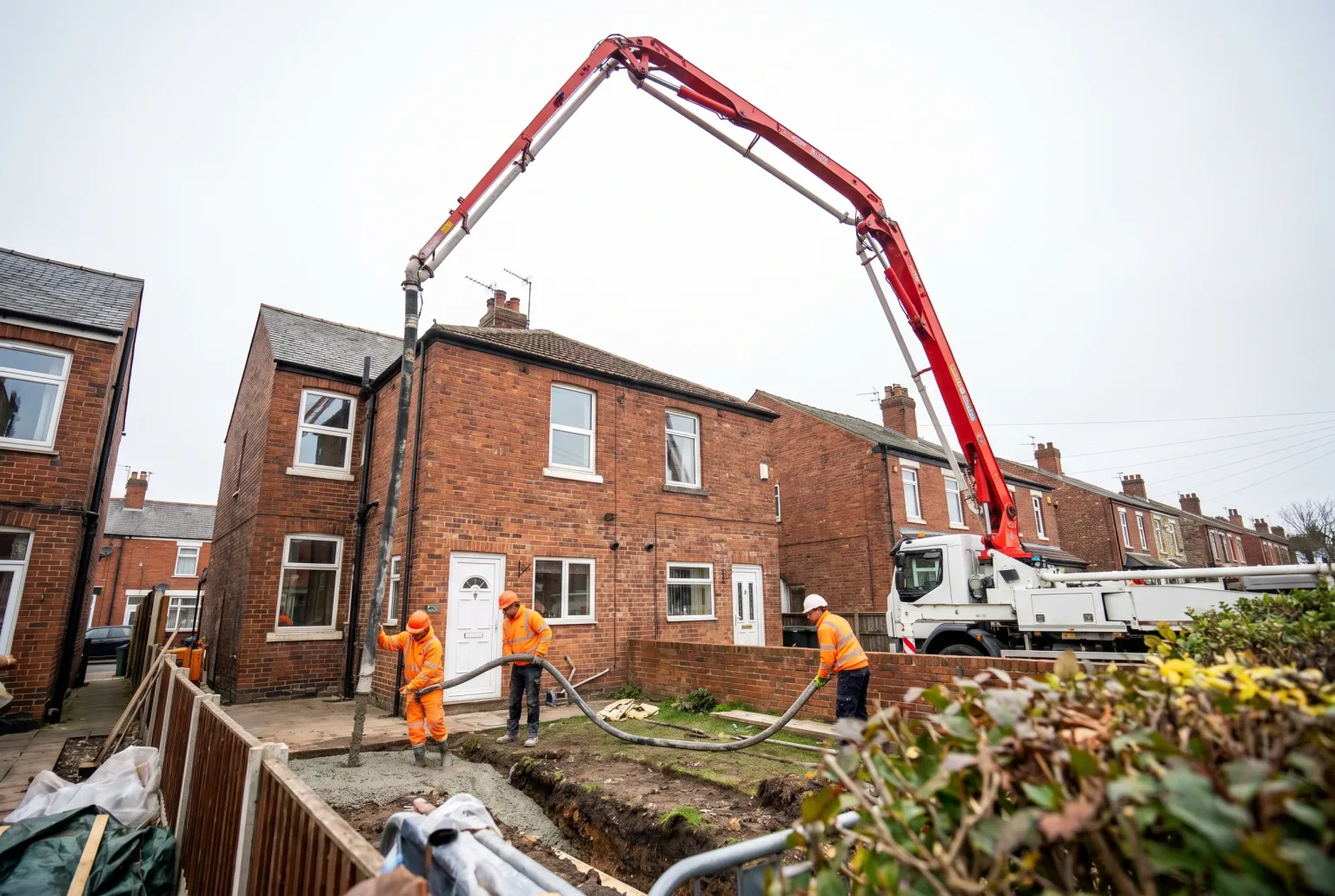
A hydraulic arm lifts concrete up and over obstacles. Used for larger commercial pours, upper-floor slabs, and where distance + height combine. More expensive.
For 90% of residential jobs, shed bases in back gardens, raised patios, basements, a line pump is what you need. Boom pumps are usually only worth the cost on 20m³+ elevated pours.
How pumping affects the mix
Pumping concrete through a 75mm hose over 50m requires a specific mix. We supply P280 pump mix as standard, it's a high-cement, higher-slump formulation designed to flow without blocking.
Key differences from a standard gravity-fed mix:
- Higher cement content, provides the lubricating paste that coats the pipe
- Smaller aggregate (10-20mm, not 40mm), fits through the line without bridging
- Higher slump (S3, typically 100-150mm), needed to flow
- Plasticiser added, reduces water needed while keeping workability
The P280 pump mix is suitable for most pumped applications. If you need a specific spec, higher strength, fibre reinforcement, SRC, let us know when booking and we'll confirm the mix design works through a pump.
Typical pump reach
Reach and rate depend on mix, pump model, pipe size and gradient. Tell us the distance and lift when booking and we'll size the pump correctly.
How to prep your site for a pump
1. Road space for the pump truck
A line pump truck is about the size of a 7.5-tonne lorry. Boom pumps need outrigger feet splayed 5-6m wide. Clear parked cars from the frontage and confirm any road-closure permits in advance.
2. Space for the concrete wagon to feed the pump
The wagon discharges into the pump hopper. Plan for two vehicles side-by-side at the pump position, one pumping while the next arrives.
3. Route for the pipe
Walk the proposed pipe route: no sharp 90° bends, no climb then drop (traps air), enough straight runs. Every 45° bend costs some reach and pressure.
4. Clean-out position
At the end of the pour the pump must be flushed. You need a space to discharge ~1m³ of flush water + wet concrete, ideally into a spoil heap, bucket, or corner of the pour.
5. Crew at the placing end
A pump delivers concrete fast, faster than two people can tamp and level. Have enough hands at the delivery end to keep up, or ask for a slower pump rate.
What does pumping cost?
Pumping charges vary by pump size and job length, but typical Midlands rates:
- Small domestic line pump, £380-£650 per visit (up to 4 hours on site)
- Larger line pump, £600-£900 per visit
- Boom pump, £900-£1,800 per visit depending on reach
- Stand-by time, £80-£150/hour if the pour runs over
These are pump-hire costs on top of the concrete itself. For a small back-garden pour of 2-4 m³, the pump often costs more than the concrete, but it's the difference between a smooth half-day pour and two days of wheelbarrow misery.
Common pumping mistakes
1. Booking the pump too small
Assuming a 24m boom will reach a 26m garden and "we'll make it work" is how pours get abandoned halfway. Measure the full distance including any dogleg around the house.
2. Not specifying pump mix
Ordinary gravity mixes can block a pump, big aggregate, low cement, low slump all cause problems. Always tell your supplier you're pumping when booking.
3. Bends, bends, bends
Every 90° bend in the line reduces reach by ~10m equivalent. Keep the route as straight as possible and use sweeping 45° bends instead of tight corners.
4. Turning up unprepared
Pumps are booked by the visit, not the hour. Being "nearly ready" when it arrives costs standby time. Have formwork, sub-base, mesh and team done before booking the arrival slot.
Before booking a pump:
- Measured the horizontal distance and any lift
- Decided on line pump vs boom pump
- Told the concrete supplier you're pumping (so they send pump mix)
- Checked road access and parking for the pump truck
- Planned the pipe route (avoid tight bends)
- Arranged enough hands at the delivery end
- Identified a clean-out discharge point
Concrete Pumping FAQs
When do you need a concrete pump?
You need a pump when a mixer truck cannot reach the pour, such as rear gardens, basements, upper floors, or pours over buildings and obstacles. Pumping is faster and safer than barrowing large volumes by hand.
What is the difference between a line pump and a boom pump?
A line pump moves concrete through ground-level hoses and suits smaller domestic pours and tight access. A boom pump uses a truck-mounted hydraulic arm to place concrete at height or over obstacles, which suits larger jobs.
How far can a concrete pump reach?
Line pumps can move concrete well over 100m horizontally. Boom pumps commonly reach 20 to 40m of height and can extend over buildings, with larger booms reaching further still.
How much does concrete pumping cost?
Pumping is charged on top of the concrete, based on pump type, volume, and time on site. Booking the pump and concrete together avoids delays. Call us for a quote based on your access and pour.
Need a pump for your next pour?
We can arrange a pump and deliver the right pump mix together, one booking, one supplier, one point of contact. Call for a quote.