Concrete Mix Grades Explained
Every ready-mix quote comes with a grade like C25/30 or C32/40. They look like tyre codes. They're actually the single most important line on the ticket, they tell you how much load the concrete will carry after it cures. Here's how to read them, and which one to order for the job you're about to pour.
Quick answer
A concrete grade like C28/35 gives the minimum 28 day strength in N/mm2 (28 cylinder, 35 cube). Higher numbers mean stronger concrete. For most domestic jobs, C28/35 covers driveways, shed bases, and patios; foundations often use C8/10 or C16/20; heavy or commercial slabs use C32/40 and above.
What the two numbers mean
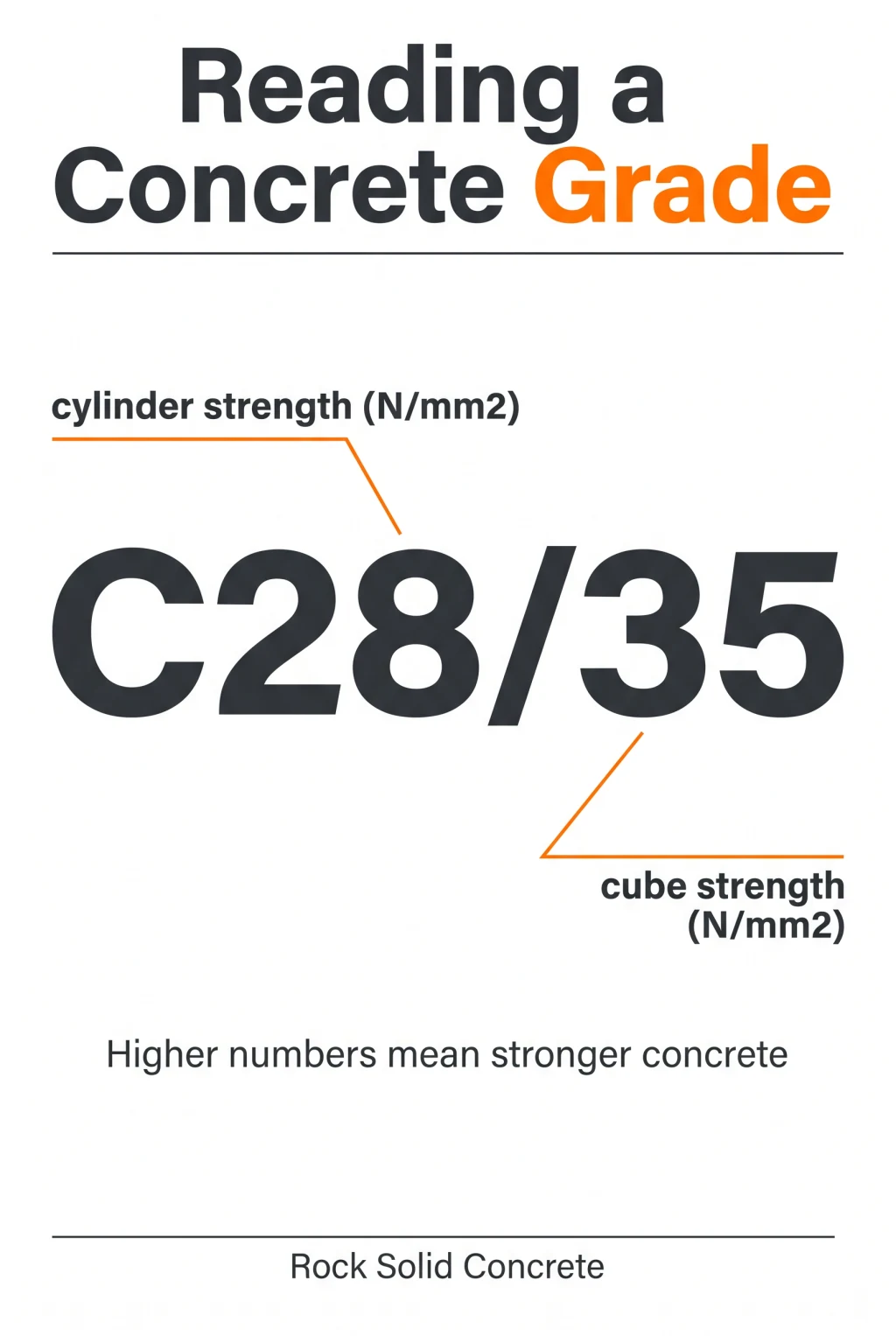
Every grade is two numbers separated by a slash, for example C28/35:
- The first number (28), minimum compressive strength of a cylinder of that concrete at 28 days, in N/mm² (MPa).
- The second number (35), minimum compressive strength of a cube of that concrete at 28 days, also in N/mm².
The cube number is always higher because cubes test stronger than cylinders for the same mix. UK engineers and BS EN 206 usually reference the cube figure, so C28/35 is often called "a 35 newton mix".
The standard grades, from weakest to strongest
"Gen" and "RC" are older UK names you'll still see on tickets, they map onto the same grades.
Which mix for which project?
Shed base, summerhouse, hot tub
C28/35. Strong enough to carry any garden structure without cracking. Standard residential default.
Single-storey extension foundation
C8/10 or C16/20. Building regs minimum. The mass of the concrete does the work, not the strength.
Double-storey or heavy-loaded foundation
C16/20 or C25/30. Structural engineer will specify, don't substitute down.
Domestic driveway
C28/35. Crack-resistant under cars and vans. Step up to C32/40 if you park a 3.5t van daily.
Garage floor / workshop
C25/30. Smooth trowel finish, easy to clean. Go C32/40 if a car ramp or hoist is going in.
Farm yard, tractor turnaround
C32/40 air-entrained. Freeze-thaw resistant. Add steel fibre or A393 mesh for load distribution.
Commercial warehouse floor
C32/40 or C35/45. Power-floated, 20-30 kg/m³ steel fibre. Spec it through a floor engineer.
Silage clamp / slurry area
C40/50 with SRC. Sulphate-resisting cement is essential. Non-negotiable for SSAFO compliance.
Air entrainment, fibre, SRC, what the suffixes mean
The grade is only half the story. Extras on the ticket tell you how the concrete will behave in service:
Air-entrained
Microscopic air bubbles are introduced into the mix. They give water somewhere to expand into when it freezes, so the surface doesn't spall in winter. Essential for external slabs that see salt, frost or freeze-thaw cycles, driveways, yards, external car parks.
SRC, Sulphate-resisting cement
Replaces standard Portland cement with a version that resists sulphate attack. Needed wherever concrete sits in contact with sulphates: clay soils high in sulphate, slurry, silage effluent, some groundwater. Ignoring it in a silage clamp rots the concrete in a few years.
Fibre reinforced
Steel or polypropylene fibres are mixed in at the plant. They spread the crack-control job across the whole slab, no mesh fixing, better distribution. Common in commercial floors and large-volume slabs.
Slump (S1 / S2 / S3)
Slump measures how wet/workable the mix is. S2 (50-90mm) is the standard for most jobs. S3 (100-150mm) flows more easily, use it when you're pumping or pouring into a tricky form. Don't request a wetter mix just to make spreading easier; you lose strength.
Common mistakes when picking a grade
1. Copying your neighbour
"My mate ordered C20/25 for his drive and it's fine", maybe, but he probably has a thicker slab or parks a hatchback, not a Hilux. Order for your loading, not his.
2. Over-specifying "just to be safe"
Ordering C40/50 for a shed base wastes money and cracks more in shrinkage than C28/35 would. Stronger isn't always better, match the grade to the job.
3. Ignoring exposure class
A driveway that's near the sea or salted every winter needs air-entrainment even at the "right" strength grade. The grade tells you load; exposure class tells you environment. Both matter.
4. Using old "Gen" names without checking
A plan that says "Gen 3" should get C16/20. If the supplier interprets it differently, you can end up with the wrong strength. Clarify the BS EN 206 grade in writing.
Quick rules of thumb
For most Midlands projects:
- Sheds, patios, domestic drives → C28/35
- Strip foundation → C8/10 or C16/20 (single-storey), C25/30 (two-storey)
- Garage floor, workshop → C25/30
- Heavy-use drive, farm yard, commercial slab → C32/40 air-entrained
- Power-floated warehouse → C32/40 or C35/45 with fibre
- Silage clamp / slurry floor → C40/50 with SRC
Concrete Mix Grade FAQs
What does the concrete grade C28/35 mean?
The two numbers are the minimum 28 day compressive strength in N/mm2: 28 for a test cylinder and 35 for a test cube. UK practice usually quotes the cube figure, so C28/35 is often called a 35 newton mix.
What concrete grade do I need for a driveway?
C28/35 is the standard for domestic driveways. Step up to C32/40, ideally air-entrained, for heavy use, daily vans, or frost exposure.
What grade of concrete is best for a shed base?
C28/35 is the usual choice for shed bases, summerhouses, and hot tub bases. It is strong enough to carry garden structures without cracking, without over-specifying.
What is the difference between GEN, ST, RC and C grades?
GEN and ST are older standardised mix names, C grades are the modern BS EN 206 strength classes, and RC grades are designated mixes for reinforced concrete. They overlap, for example GEN3 maps to about C16/20.
Is a higher concrete grade always better?
No. Over-specifying wastes money and can crack more from shrinkage. Match the grade to the load: C28/35 suits most domestic slabs, with higher grades only where loading or exposure demands it.
Not sure which grade you need?
Tell us what you're pouring and we'll recommend the right mix, slump and reinforcement in a two-minute phone call. Next-day delivery across the Midlands.