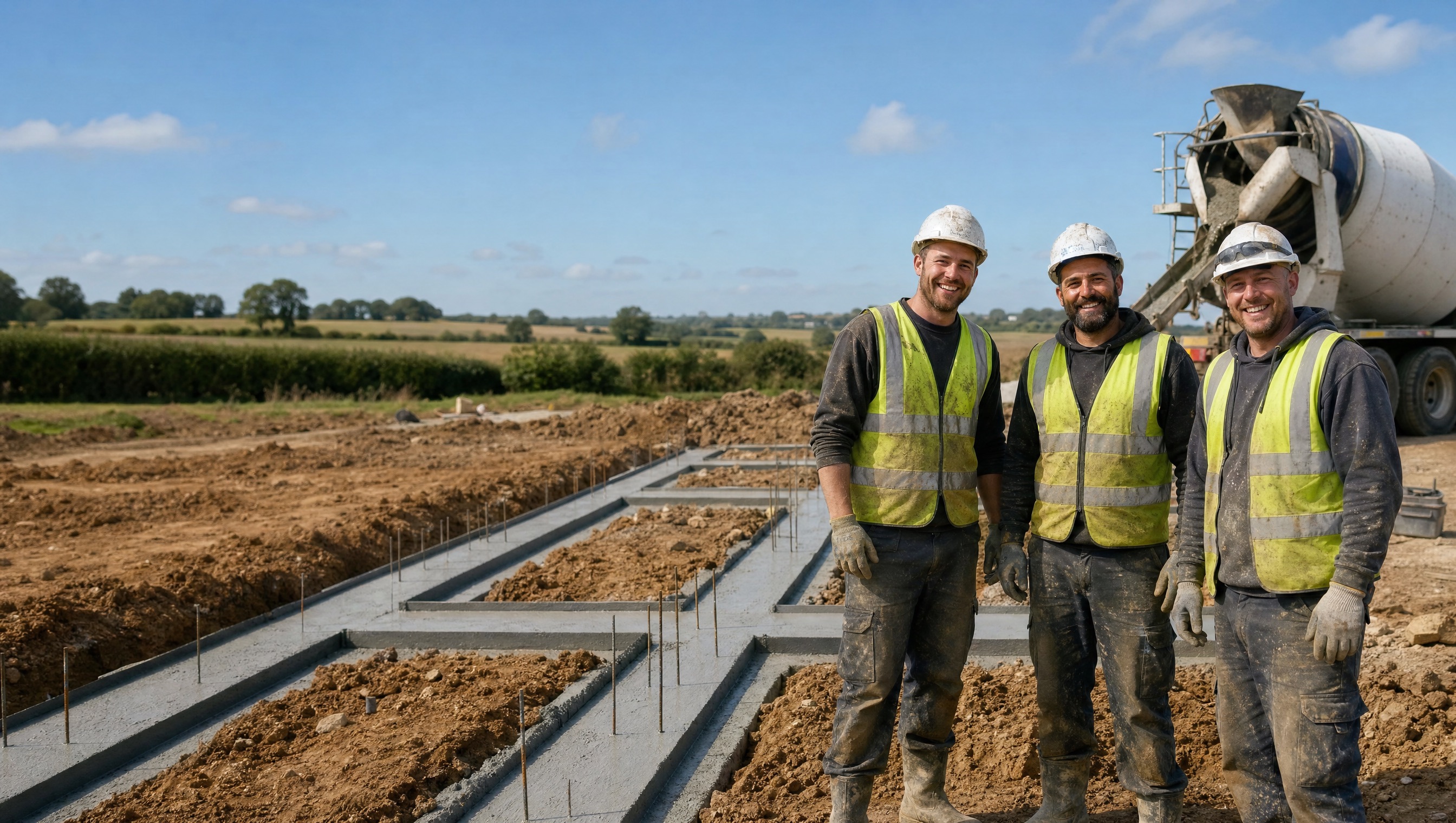
Strip Foundations
Poured straight in.
C25/30 ready-mix delivered to your trench. Single and two-storey extensions, detached garages, garden walls. Building-control compliant, instant pricing.
The Mix You Need
C25/30 Foundation Mix
- Mix grade
- C25/30 or C28/35
- Slump
- 75-100mm
- Aggregate
- 20mm
- Typical width
- 450-600mm
- Typical depth
- 225-300mm (pour depth)
- Excavation depth
- 1.0m minimum (UK building regs)
Volume Guide
How much concrete for your foundations?
Volumes shown include 10% wastage. Volume = width × depth × total trench length, use our calculator for exact figures.
Small extension
4m × 4m footprint
16 lm of 450×300 footing
Medium extension
6m × 4m footprint
20 lm of 450×300 footing
Large two-storey extension
8m × 5m footprint
26 lm of 600×300 footing
Detached garage
6m × 6m
24 lm of 450×300 footing
Why It Matters
Get this right and you won't redo it for 30 years
- Strip foundations are the most common foundation type for domestic extensions and garages, but only when the soil is firm and stable.
- Building regs require footings to reach undisturbed, load-bearing ground, typically 1.0m deep minimum, deeper on clay or near trees.
- A 450mm × 300mm strip with C25/30 carries a standard single or two-storey brick/block wall comfortably. Spec up for heavier loads.
- Ready-mix eliminates the inconsistency of site-mixed footings, every metre of your foundation gets the same strength, every time.
Step by Step
How to prepare & pour
Soil investigation
Before you dig, know your soil. Sandy/gravel = strip footings are ideal. Clay, fill, or near trees = you may need trench fill, raft, or piles. Talk to a structural engineer if unsure.
Excavate to depth
Dig the full trench to 1.0m below ground level (or deeper if clay/trees) and at least 150mm wider than the footing. Keep the sides vertical and remove all loose soil from the base.
Building control inspection
Your local Building Control Officer must inspect the open trench before concrete is poured. Book this 24-48 hours before pour day.
Level pegs
Drive steel pins or timber pegs into the trench bottom at the finished footing height. These guide the depth of pour and keep the top level for the brickie.
Order ready-mix
Calculate volume: width × depth × total trench length, plus 10% wastage. Our calculator does it in 30 seconds. Book your delivery slot online or by phone.
Pour & tamp
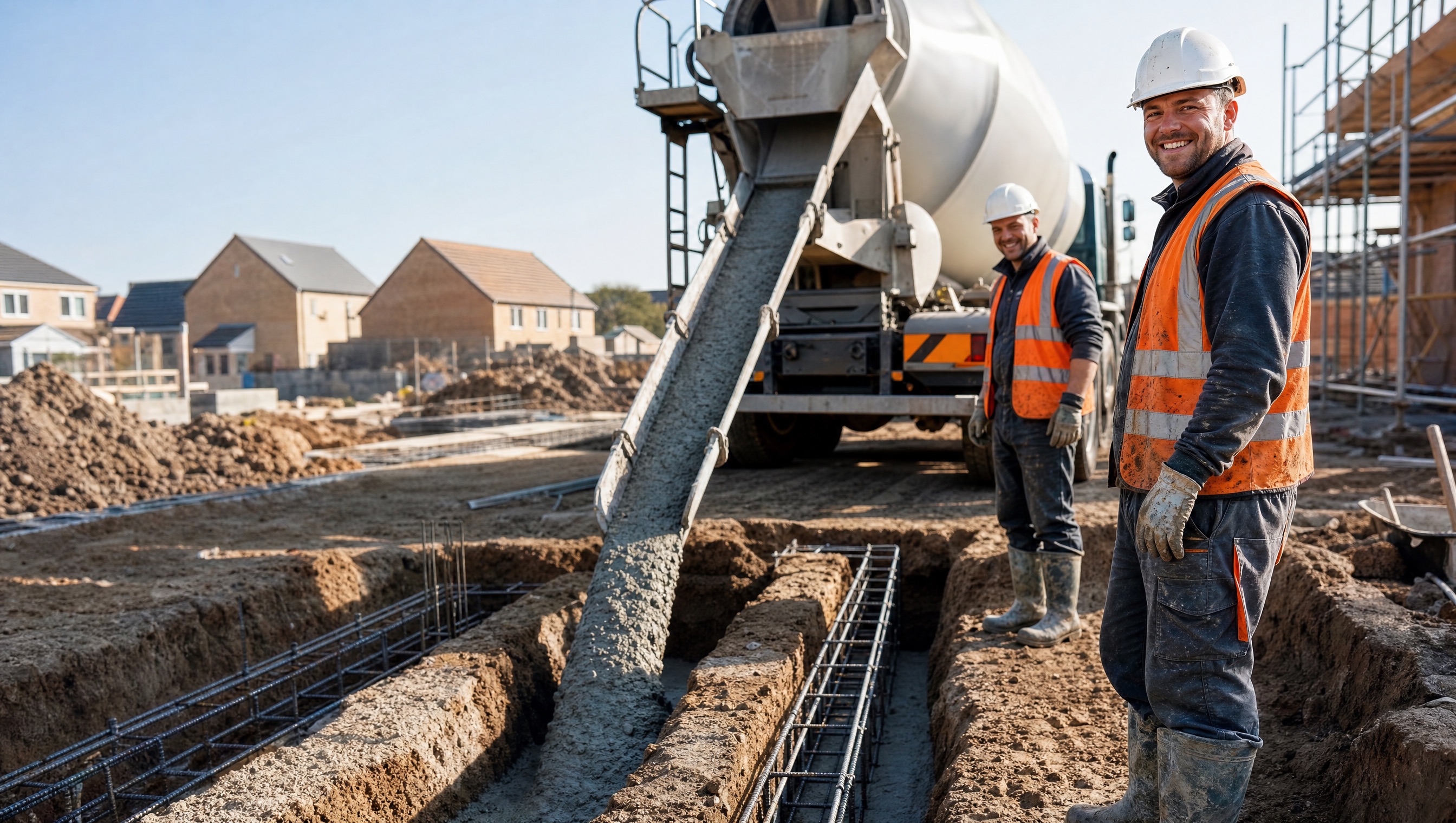
Discharge direct into the trench from the chute where access allows. Tamp with a straight-edge or vibrator to remove air pockets. Level to the pegs and leave to cure 24 hours before first blocks.
FAQ
Common questions
What's the difference between strip and trench fill?
Strip = a shallow band of concrete at the bottom of a 1m-deep trench, then brick/block built up to ground level. Trench fill = concrete fills the whole trench to near ground level in one pour, skipping the underground masonry. Trench fill is faster but uses more concrete, see our trench fill guide.
How deep do strip foundations need to be?
1.0m minimum to undisturbed subsoil is the standard UK figure. Clay soils need 1.0-1.5m, and if there are trees nearby the NHBC foundation depth tables may require 2.0m+. Check your soil type and always follow Building Control's instruction on site.
What mix grade do I need?
C25/30 is the standard spec for domestic strip foundations. For exposed ground conditions or sulphate-bearing soils, you may need sulphate-resisting cement (SRC), your Building Control or engineer will specify this.
Do I need reinforcement in the strip?
Typically no, for standard domestic work on stable ground. If you're bridging soft spots or on reactive clay, an engineer may spec rebar. Assume no rebar unless specifically told otherwise.
How much concrete do I need?
Multiply footing width × footing depth × total trench length, then add 10% for wastage. A 450mm × 300mm footing running 20m total = 0.45 × 0.3 × 20 = 2.7 m³ + 10% = order 3.0 m³. Use our calculator.
Can you pump into difficult access?
Yes. If the trench is round the back of the house or through a narrow side access, we'll arrange a pump. Pumps reach 30m+ horizontally and are cheaper than barrowing 4m³ through a side gate.
Ready to order?
Instant price in 60 seconds. Next-day delivery subject to availability. With volumetric, pay only for what's poured.