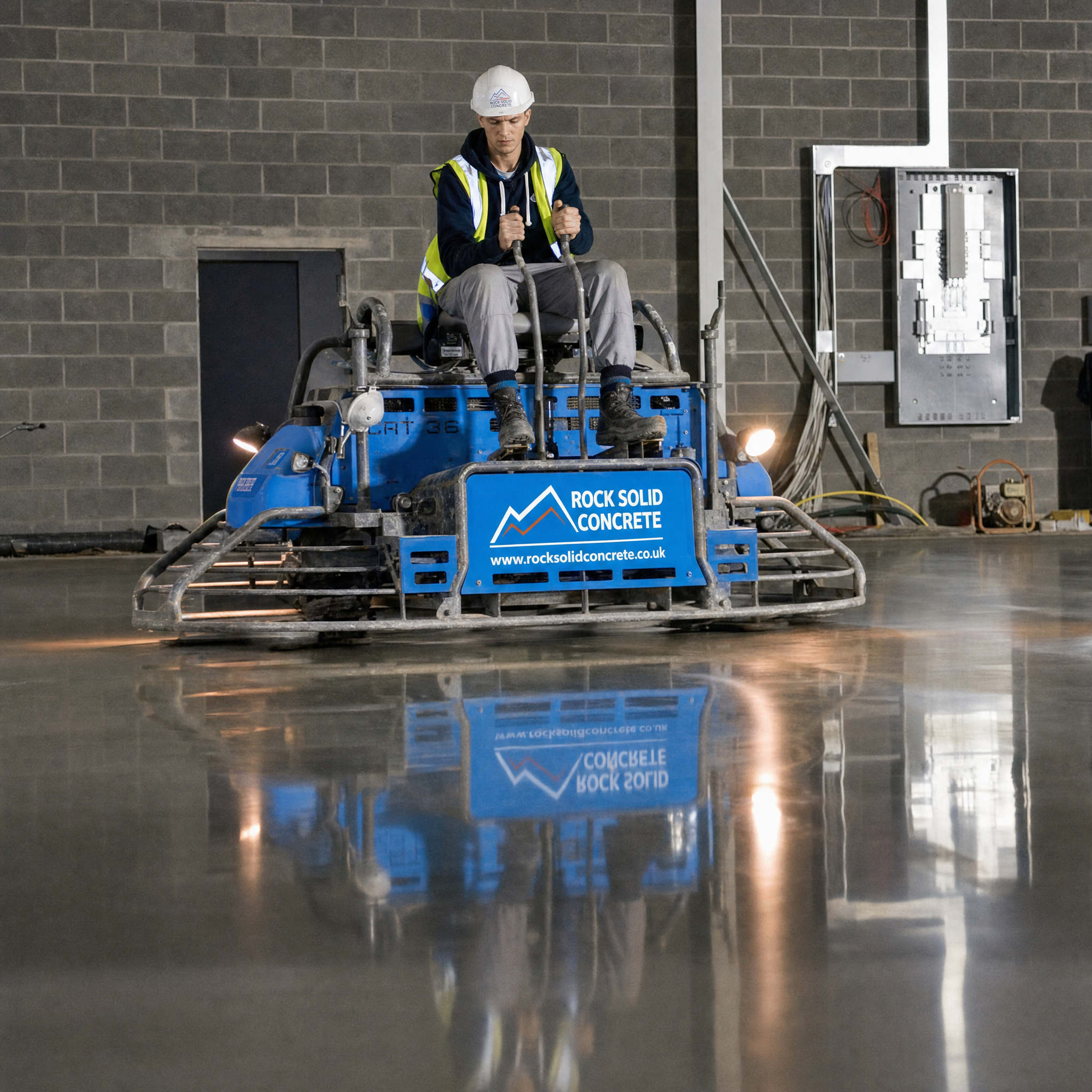
Commercial Floor Slabs
Power-floated, forklift-ready, engineered.
C32/40 or C35/45 with A393 mesh or 25 kg/m³ steel fibre. Laser-screeded, power-floated, BCO paperwork ready. 100m³+ per day from two Midlands plants.
The Mix You Need
C32/40 Commercial Floor Mix
- Mix grade
- C32/40 or C35/45 power-float grade
- Slump
- 75mm (S2/S3)
- Aggregate
- 20mm
- Slab depth
- 150-200mm
- Reinforcement
- A393 mesh or 20-30 kg/m³ steel fibre
- Sub-base
- 150-225mm Type 1 MOT on DPM
Volume Guide
How much concrete for your floor?
Volumes shown at 200mm depth. For large pours we run both plants simultaneously, 100m³+ in a single day is routine with 2 weeks' notice.
Small workshop
10m × 8m
200mm depth
Trade unit
15m × 12m
200mm depth
Warehouse bay
20m × 15m
200mm depth
Industrial shed
30m × 20m
200mm depth
Why It Matters
Get this right and you won't redo it for 30 years
- Commercial floors see forklifts, pallet trucks, racking legs, and point loads no domestic slab was designed for. You need an engineered spec from day one.
- A power-floated surface is dust-resistant, easy to clean, and dramatically harder than a standard trowel finish, essential for warehouses, workshops, and food-grade units.
- Steel-fibre reinforcement distributes crack risk across the whole slab and replaces mesh labour. On large pours it pays for itself in time saved on site.
- Continuous pour from our two Midlands plants keeps the slab monolithic, no cold joints, no surprise cracks at the wrong line. Wagons rotate every 15-20 minutes.
Step by Step
How to prepare & pour
Get the design right first
For racking or heavy point loads, get a structural engineer to spec slab depth, mesh/fibre dose, and joint layout. An hour of engineering saves £10k of remedial work later.
Sub-base & DPM
Compact 150-225mm of Type 1 MOT in 75mm layers. Lay 1200-gauge DPM over the sub-base with 300mm laps taped, critical for damp-proofing a warehouse floor.
Edge formwork & insulation
Set perimeter formwork to the finished slab level. For heated or insulated buildings, add 50-100mm PIR under the slab before pouring. Install edge insulation strips to prevent cold bridging.
Mesh or fibre
A393 mesh on 50mm spacers for conventional design, or specify 20-30 kg/m³ steel fibre for faster pours and better crack distribution. For very heavy loads, use both.
Pour & level
Pour continuously, laser-screed or tamp to level, bull-float to close the surface. Time the power-float entry window carefully, too early ruins the finish, too late is impossible.
Power-float, cut joints, cure
Power-trowel to the specified surface grade (standard, FM2, or FM3). Saw-cut contraction joints within 24 hours at ~6m spacing. Cure with curing compound or polythene for 7 days minimum.
FAQ
Common questions
What mix should I use for a warehouse floor?
C32/40 minimum for general warehousing. For high-racking, heavy forklifts or food production, specify C35/45. Both are available air-entrained if freeze-thaw exposure is a risk (e.g. loading bays with open doors).
Mesh or steel fibre, which is better?
Steel fibre usually wins on big commercial pours: no fixing labour, no displaced mesh from foot traffic, better distributed crack control. Mesh still has a place on smaller slabs and where a specifier requires it. We can supply either.
How flat does the floor need to be?
For general use, Concrete Society TR34 "regular movement" (FM3) is typical. Defined-movement areas (narrow-aisle racking) need FM1 or FM2, that demands laser-screed placement and an experienced flooring contractor. We supply the concrete; we can also recommend contractors we trust.
Can you do 100m³+ in a single day?
Yes, our Coventry and Melton Mowbray plants combined deliver 100m³+ per day with pre-booking. For very large pours we schedule wagons every 15-20 minutes for a continuous pour with no cold joints. Book 2 weeks ahead for anything over 80m³.
How long before the floor can take racking / forklifts?
7 days for foot traffic, 14 days for light vehicle use, 28 days for full design load. Curing is critical in the first 7 days, cover and keep damp or use a curing compound. Racking install usually starts at 28 days when the slab has reached specified strength.
Do you supply for design-and-build groundworkers?
Yes, we work with groundworkers and M&E contractors across the Midlands. Trade accounts, priority booking, paperwork for the BCO, and a direct line to the batching office. See our groundworkers page.



Ready to order?
Instant price in 60 seconds. Next-day delivery subject to availability. With volumetric, pay only for what's poured.