Preparing for a Concrete Delivery
Ready-mix concrete has a roughly 90-minute window from leaving the plant to being in place on site. If your site isn't ready, you waste the load, and we charge for it. Here's exactly what to have done before the wagon arrives.
Quick answer
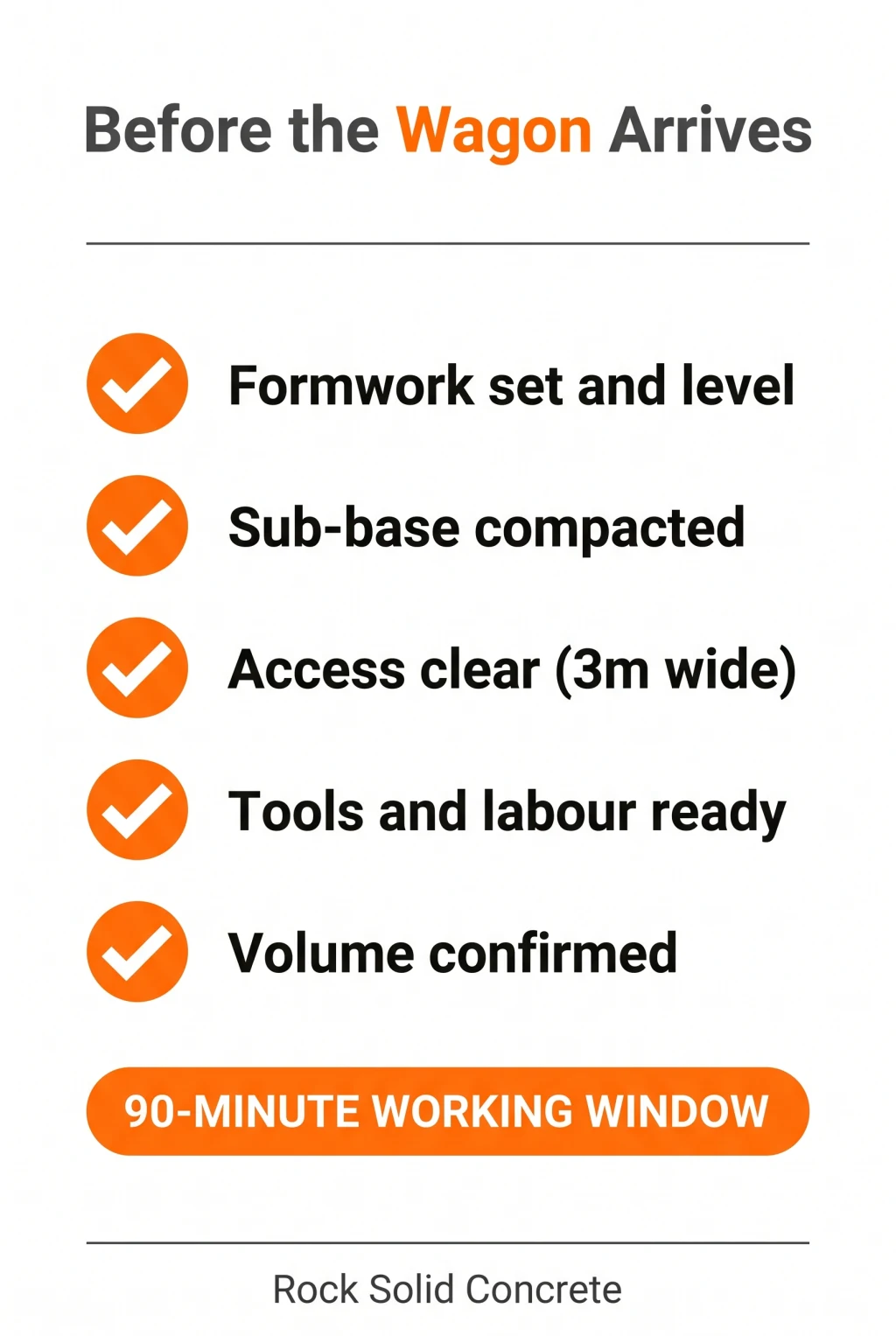
Before the truck arrives, set and check your formwork, compact the sub-base, clear truck access, line up tools and labour, and confirm your volume. Ready-mix has about a 90 minute window, so a site that is fully ready avoids wasted loads and standing charges.
1. Confirm Access for the Wagon
A standard 8-wheel ready-mix wagon weighs around 32 tonnes loaded, needs 3.5m of headroom, and wants a turning circle of about 15m. Before the wagon leaves the plant, walk the route from the road to the pour point and check:
- Overhead obstacles, tree branches, power cables, telephone wires (3.8m clearance needed)
- Width restrictions, narrow lanes, gate posts, overhanging hedges
- Weight-bearing surfaces, block paving, thin tarmac, soft verges can crack or sink under a loaded wagon
- Reversing lines, the driver needs to see the pour point or have a banksman directing
- Distance from wagon to pour, standard chutes reach about 3m. Beyond that you need a pump or barrow run
If access is tight, tell us when you book. We'd rather send a 4-wheel mini-mix or arrange a pump than have a full wagon turn away from your gate.
2. Complete Your Sub-Base
Concrete is only as good as what it sits on. Your sub-base must be:
Fully compacted
Type 1 MOT laid in 50mm lifts, whacker-plated between each. The surface should ring solid under the plate.
Correct depth
Usually 100mm for shed bases, 150mm for driveways, 200mm+ for farm yards. Higher for clay soils.
Level
Check across the full area with a straightedge. A "good enough" sub-base becomes a "bad" slab.
Free of standing water
Rain overnight? Bail it out or delay the pour. Water under the DPM weakens the slab.
3. Install DPM & Formwork
Before the wagon arrives:
- Lay 1200-gauge damp-proof membrane (DPM) over the sub-base, with 150mm overlaps taped at any joints
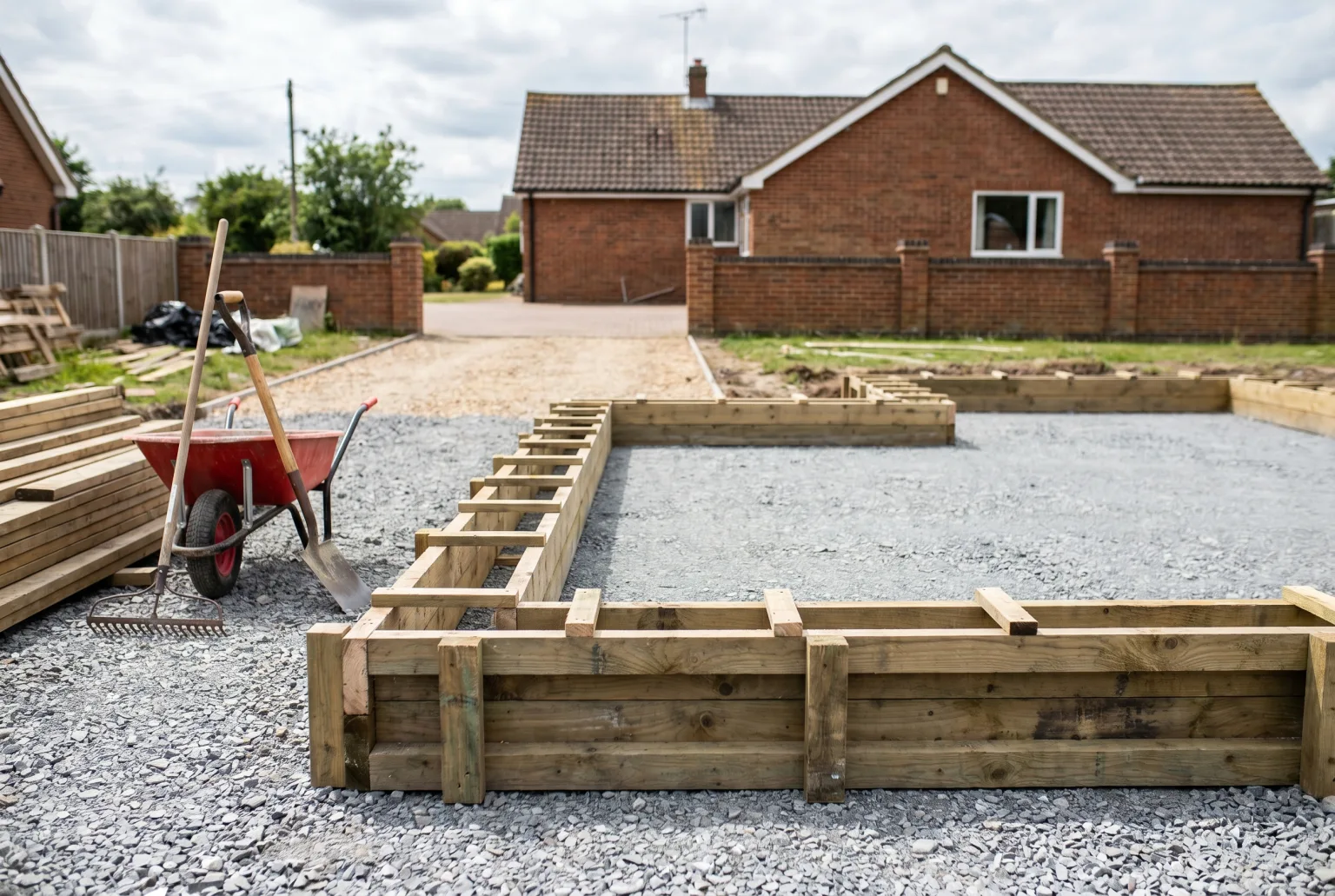
- Build timber formwork to the finished slab level, check with a spirit level or laser, not by eye
- Brace formwork with pegs every 600mm, fresh concrete exerts serious outward pressure
- Grease or oil the inside of the formwork if you want a clean release afterwards
For larger slabs, set level pegs across the pour area at the finished height. These guide screeding and stop a high or low finish.
4. Reinforcement in Place
If your mix spec calls for reinforcement:
- A142 or A193 mesh on 50mm plastic spacers, never lay directly on the DPM
- Overlap mesh sheets by at least 300mm and tie with wire
- The mesh should sit in the lower third of the slab thickness
- For structural pours, your engineer may specify rebar with specific cover, follow the drawing
5. Tools & People on Site
The pour itself is time-sensitive, here's what you need within arm's reach:
People
Minimum 2 people. Minimum 3 for pours over 3m³. One tamps, one screeds, one floats and watches the wagon.
Tools
Rake, shovel, tamp bar or straightedge, bull float, wheelbarrow, wellington boots, gloves. Power trowel for bigger areas.
Water supply
Hose with mains pressure, you'll need it to wash tools, rinse the chute, and clean up.
Cover
Polythene sheets ready to cover the slab after finishing, especially in hot sun, frost, or heavy rain.
6. Timing the Delivery
Concrete starts its chemical reaction the moment water meets cement. From there:
- 0-30 mins after delivery, best time to pour, tamp and screed
- 30-60 mins, still workable, but starting to stiffen
- 60-90 mins, last usable window; the mix will be getting harder to move
- 90+ mins, starting to take initial set; quality suffers
Give us your site address when you book and we'll time the wagon so it arrives as you're ready to pour, not an hour before.
7. Common Mistakes That Waste Money
- Over-ordering "to be safe", our calculator adds 10% wastage automatically. Beyond that, you're paying for concrete you don't need.
- Under-ordering, running short mid-pour means a cold joint (the weakest point in a slab) or a second short-load delivery at premium rates.
- Not confirming access, wagons turned away still cost. Confirm everything at the booking stage.
- Starting the pour without enough hands, the mix doesn't wait for you. Have your team on site before the wagon arrives.
- Skipping the cover, fresh concrete dries out in sun or blows rain bubbles into the finish. Cover it for the first 24 hours.
The Day-Before Checklist
Work through this the evening before your pour:
- Sub-base fully compacted and level
- DPM laid with 150mm overlaps
- Formwork pegged and braced
- Reinforcement mesh in place on spacers
- Access checked for wagon, overhead, width, weight
- Tools and wheelbarrows on site
- Mains water available for wash-down
- Polythene or tarp ready for covering
- 2+ people booked for the pour
- Exact pour time confirmed with us
Concrete Delivery Prep FAQs
How do I prepare for a concrete delivery?
Have your formwork set and checked, the sub-base compacted, access clear for the truck, tools and labour ready, and your volume confirmed. Ready-mix has roughly a 90 minute working window, so be ready before it arrives.
How much access does a concrete mixer need?
A standard mixer truck needs firm ground, about 3m of width, and clear height. If access is tight or the pour is far from where the truck can park, arrange a pump or smaller mini-mix in advance.
What happens if my site is not ready?
If concrete cannot be placed in time it can go off in the truck, and you are charged for the wasted load plus any standing time. Preparing fully in advance avoids these costs.
How long does ready-mix concrete last once delivered?
Roughly 90 minutes from leaving the plant in normal conditions, and less in hot weather. Plan to place and finish within that window, or split a large pour into stages.
Order with Confidence
Our team has poured thousands of slabs across the Midlands, if you're unsure about anything, call us before the delivery day. It costs nothing to get it right.