Winter Concrete Pouring
Concrete cures by chemistry, and chemistry slows down when it's cold. Below 5°C the reaction almost stops; below freezing a fresh pour can be permanently damaged by ice crystals forming inside it. This guide covers what to do, what to skip, and when to just postpone.
Quick answer
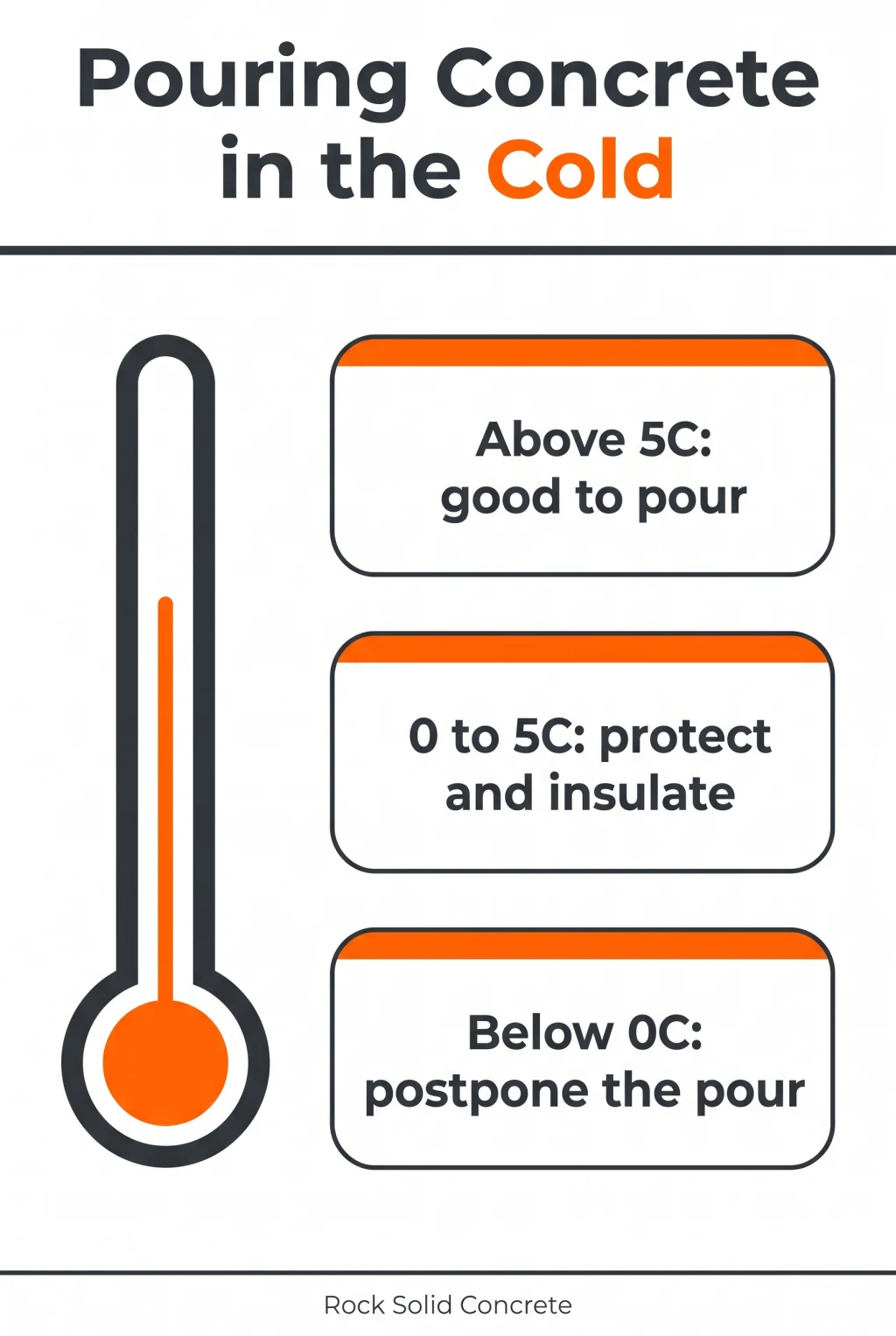
You can pour concrete in winter with care. Protect it from frost, use warm or accelerated mixes, and insulate the slab. Below 5 degrees Celsius curing slows sharply, and a pour that freezes early can be ruined, so in hard frost it is safer to postpone.
The temperature rules
What matters is the temperature of the concrete, not the air. A fresh pour is warm from the chemical reaction, but the surface follows air temperature fast, especially in wind.
Why cold weather is dangerous for fresh concrete
Hydration stalls
The cement-water reaction is temperature-dependent. At 5°C it's half the speed of 20°C. Below 0°C it essentially stops, the slab won't gain strength until it warms up again.
Ice crystals
If water in fresh concrete freezes, the expansion (9%) cracks the cement paste from the inside. You can't see the damage, but strength drops by 30-50% and it's permanent.
Surface scaling
Even once the slab has set, repeated freeze-thaw on a half-cured surface flakes off the top. You end up with a pitted, dusty top that has to be resurfaced.
Delayed strength
A slab that was slow-cured in cold weather gets to 28-day strength at maybe 45-60 days. Plan any follow-on trades accordingly.
Cold-weather admixtures & mix adjustments
Accelerator
A chemical accelerator (typically calcium chloride-free for modern mixes) speeds up the set and heat-generation so the slab gets through the vulnerable early hours faster. Usually adds 30-50% to early strength at 24 hours. Ask for it at the plant; don't add it on site.
Higher cement content / higher grade
More cement = more heat of hydration = faster early strength. Going from C25/30 to C32/40 helps more than most people realise in winter.
Hot water mix (plant-heated)
The batching plant can mix with warm water, raising pour temperature to 20-25°C. Useful for winter morning pours. Ask when booking, needs warning.
Air entrainment
Not for set-time, but critical for the slab's freeze-thaw resistance after cure. Any external winter slab (driveway, yard, patio) should be air-entrained as standard.
On-site protection, what to do after the pour
1. Cover immediately after finishing
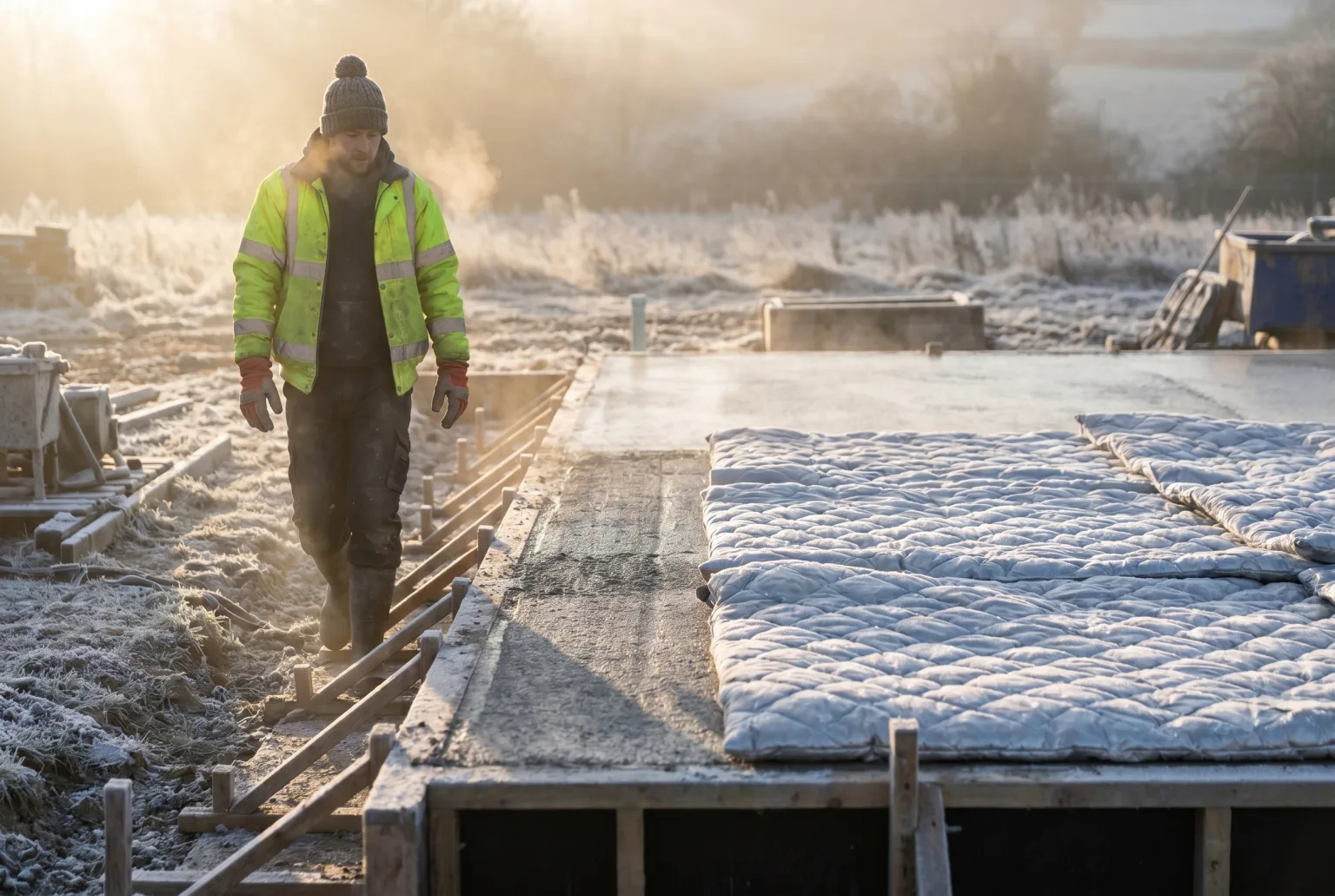
The moment the trowelling is done, cover the slab with polythene then an insulating layer, hessian blankets, thermal curing blankets, or even straw. Insulation traps the heat of hydration inside the slab.
2. Keep formwork on longer
Formwork acts as insulation. In summer you might strip vertical forms in 24 hours; in winter leave them on for 3-5 days.
3. Monitor with a thermometer
A cheap infrared thermometer lets you check the surface temperature. Aim to keep the concrete above 5°C for at least the first 72 hours.
4. Don't lift covers to admire your work
Every time you pull back the polythene, heat escapes. Leave it alone for 48 hours minimum.
5. Plan for longer wait times
A winter slab needs at least 50% longer wait times before foot traffic, vehicles and loading. A 7-day "park a car on it" becomes 10-12 days. See how long concrete takes to set.
When to just postpone
There's a point where being clever with accelerators and blankets is false economy. Postpone if:
- Forecast shows overnight temperatures below -3°C for the first 3 nights
- The slab is thin (<100mm), not enough thermal mass to retain hydration heat
- You can't cover / insulate (windy exposed site, large commercial floor)
- You're pouring onto frozen ground, the subgrade steals heat from the slab and the bond fails
- It's pouring rain + near freezing, worst possible combination
Rescheduling is usually cheaper than remedying a frost-damaged slab, which often means demolition.
Winter pouring mistakes we see every year
1. Pouring on frozen sub-base
"It's fine, it's only the top that's frozen", no. The sub-base has to be above freezing or the slab will bond poorly and form an ice layer at the interface. Cover the prepped sub-base overnight before pour day.
2. Trusting a "mild" forecast
A forecast of 4°C at 9am can easily be 0°C at 3am. Check the overnight low, not the day peak, that's when the slab is most vulnerable.
3. Not telling the supplier
The plant can add accelerator, use hot water, and book a wagon with a shorter travel time to keep heat in. But only if you tell them the job is cold-sensitive when booking.
4. Removing covers too early
"Looks set" ≠ "cured". The first 3 days are the critical window. Leave the insulation on for at least 72 hours after the pour.
5. Power-washing or salting the new slab
Don't salt a fresh external slab, de-icing salts attack un-cured concrete. Use grit, or wait until spring.
Winter pour-day checklist:
- Overnight lows checked for 3 nights following the pour
- Sub-base covered overnight, checked for frost
- Supplier told it's a cold-weather pour (accelerator, hot water)
- Polythene + insulation blankets on site, ready to deploy
- Formwork will stay on for 3-5 days minimum
- Follow-on trades informed, wait times are longer in winter
- Plan B date if forecast drops below -3°C overnight
Winter Concrete Pouring FAQs
Can you pour concrete in cold weather?
Yes, with precautions. Concrete can be poured down to about 0 to 2 degrees Celsius if you protect it from frost, use warm or accelerated mixes, and insulate the pour. Below freezing without protection, postpone.
What temperature is too cold to pour concrete?
Below 5 degrees Celsius hydration slows sharply, and a fresh pour that freezes before reaching about 5 N/mm2 can be permanently damaged. Most suppliers advise extra measures below 5 degrees and postponing in hard frost.
How do you protect concrete from frost?
Use insulating blankets or frost sheets, cover with polythene, keep the mix warm with accelerator admixtures, and avoid pouring onto frozen ground. Leave the protection in place for several days while early strength develops.
Does concrete take longer to cure in winter?
Yes. Cold weather slows hydration, so concrete gains strength more slowly and needs longer before loading or striking formwork. Allow extra time and keep it protected through the first week.
Pouring this winter?
Tell us the date and the forecast and we'll recommend the right mix, admixtures and slot. In some cases we'll suggest postponing, we'd rather you pour it right than pour it twice.