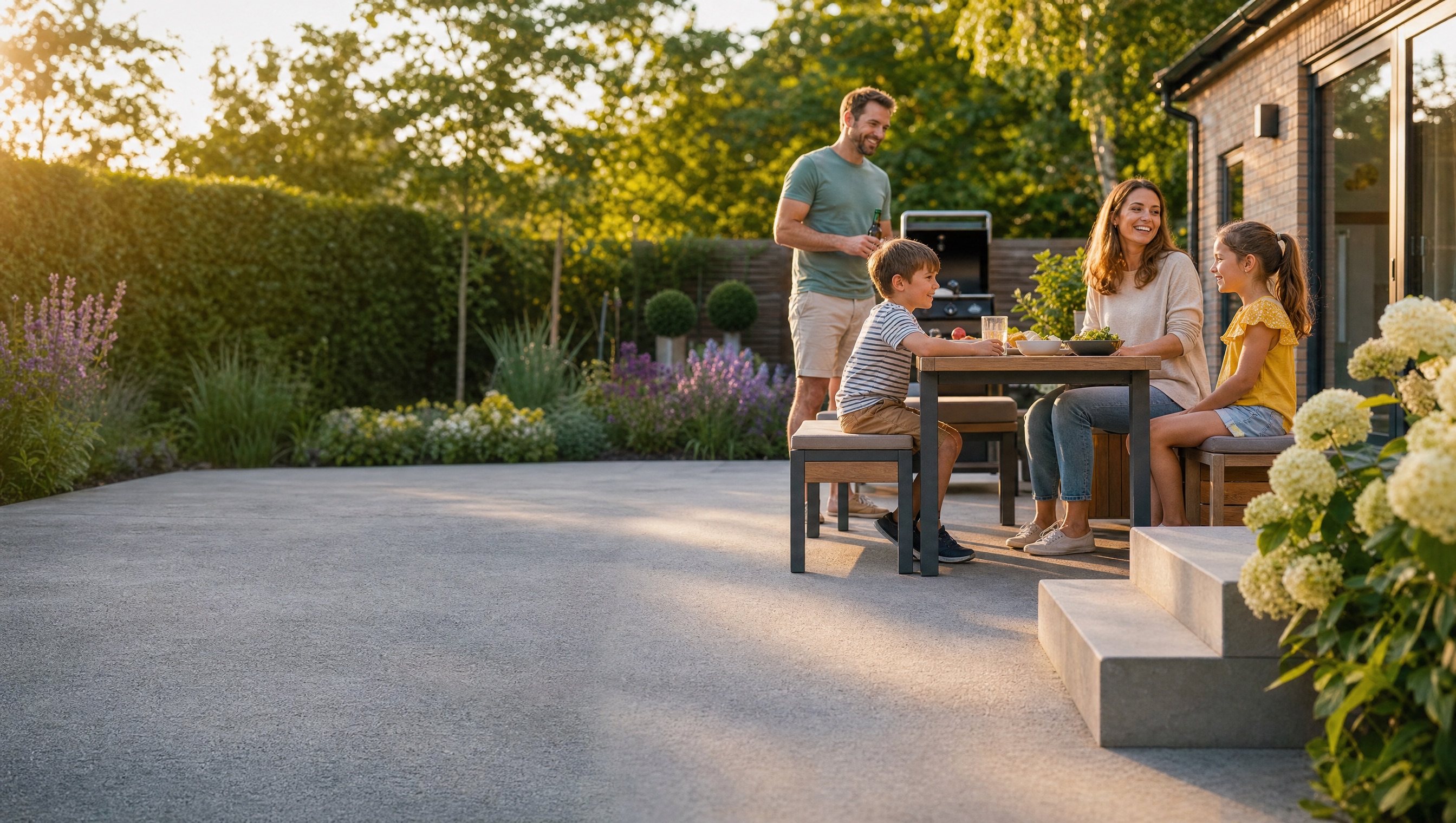
Concrete Patios
One pour. 30 years.
A third the price of flagstones. Zero weeds. Zero re-pointing. Brushed, stamped, coloured or power-floated finishes, delivered ready to pour.
The Mix You Need
C25/30 or C28/35 Patio Mix
- Mix grade
- C25/30 or C28/35
- Slump
- 50-75mm (stiffer for stamping)
- Aggregate
- 10mm or 20mm
- Slab depth
- 100mm
- Sub-base
- 100-150mm Type 1 MOT
- Finish options
- Brushed · Stamped · Power-floated · Coloured
Volume Guide
How much concrete for your patio?
Volumes based on a 100mm slab. Use our calculator for exact m³, 10% wastage included.
Small patio
3m × 3m
9 m² seating area
Standard patio
4m × 5m
20 m², table & 6 chairs
Large entertaining area
5m × 7m
35 m², dining + lounging
Full-width garden
6m × 10m
60 m², seating, dining, BBQ zones
Why It Matters
Get this right and you won't redo it for 30 years
- A concrete patio is 1/3 the price of equivalent natural stone and lasts 30+ years with near-zero maintenance.
- Stamped or brushed concrete can mimic flagstone, slate, timber, or cobble, for a fraction of the cost of the real thing.
- Continuous concrete means no weed lines, no sinking slabs, no re-pointing every 5 years. Pour once, forget about it.
- With integral colour + finish retarder, your patio looks bespoke, but behaves like a slab engineered to last.
Step by Step
How to prepare & pour
Mark out & excavate
Mark the patio boundary with string lines. Dig to 200mm below finished level (100mm sub-base + 100mm slab). Check for a 1:80 fall away from the house for drainage.
Compact sub-base
Lay and compact 100-150mm of Type 1 MOT. Whacker-plate in 50mm lifts. The higher Type 1 depth the better on clay soils.
Formwork & expansion joints
Build timber formwork to the finished level. For patios over 20m², plan expansion joints every 4-5m using plastic strips or saw-cut joints after curing.
DPM (optional) & mesh
DPM under the slab stops ground moisture bleeding through a coloured finish. A142 mesh on spacers adds crack resistance for larger patios or heavy-use areas.
Pour & finish
Pour C25/30 or C28/35 at 100mm. Screed level, then choose your finish: brushed (textured, slip-resistant), stamped (pattern rolled in fresh), power-floated (smooth, polished), or exposed aggregate.
Cure & seal
Cover with plastic for 24 hours to slow-cure. Walk on at 48 hours. After 14 days, apply a concrete sealer to lock in colour and prevent staining. Re-seal every 3-5 years.
FAQ
Common questions
What mix for a concrete patio?
C25/30 is standard for a residential patio. C28/35 if you want a bit more durability under heavy furniture or planters. Both handle garden traffic and light vehicles without issue.
Can I get coloured concrete?
Yes, integral colour added at the plant (red, buff, charcoal, black, green tones). More consistent than surface-applied dyes. Call 024 7636 1448 with your colour and we'll confirm availability and cost.
How do stamped / imprinted patios work?
Pour the slab, wait 30-60 minutes for initial set, apply release powder, then press textured mats into the wet concrete. Creates a flagstone, slate, timber or cobble effect. We can supply the mix spec with extended slump time for stamping.
Will a concrete patio crack?
Properly designed and poured, only hairline (controlled) cracks. The mix, sub-base, mesh, and saw-cut expansion joints together prevent major cracking. Cheaper than flagstones moving and lifting over a decade.
Do I need drainage?
Yes. All patios should fall away from the house at 1:80 minimum (roughly 1cm per metre). For larger patios, consider a channel drain along one edge that ties into a soakaway or downpipe.
How does it compare to paving slabs?
Concrete patio = 30% cheaper upfront, zero pointing, no weeds between joints, and lasts 2-3× as long. Paving is easier to replace one slab if damaged. Both have their place, concrete wins on long-term value.
Ready to order?
Instant price in 60 seconds. Next-day delivery subject to availability. With volumetric, pay only for what's poured.